Stakeholder Management, UX Consulting, & Customer Education

The Detroit Economic Growth Corporation (DEGC) has launched and is continuing to develop the BuyDetroit online procurement portal. The overall goal of the procurement portal is to bring more Detroit-based, diverse, small businesses into the arena of procurement. In addition to the features on the portal which support procurement processes, the BuyDetroit portal will also contain an educational curriculum to prepare inexperienced suppliers to participate in the procurement process.
Where our work begins
Our team’s work begins with the educational aspect of the BuyDetroit portal. Our team was tasked with designing the experience for the educational modules in the portal while considering the needs of users on both sides of the procurement process.
Before designing, our team conducted survey and interview research with small suppliers who will be the primary users of the educational modules as well as Buyers Council members who are helping fund the BuyDetroit portal
and are invested in seeing suppliers learn and succeed. Next, our team conducted research on the platform on which the portal lives and therefore where the educational modules will live called Connect Space. This part of our research was imperative in understanding the constraints under which the educational module would be designed.
Our final recommendation overview
Ultimately we created two sets of final designs for the educational modules—one set of designs that can be implemented in the Connect Space environment and one set of “ideal” designs that could be implemented if there were no creative constraints. Connect Space is an event planning and hosting platform and thus is serviceable but not ideal for implementing educational modules.
However, we do believe the overall goals of the program can be achieved through Connect Space and feel that this option better fits DEGC’s current budget and timeline. While Connect Space is our main recommendation, we also acknowledge that an alternative learning system could be a solution that might solve more of the clients problems, but would cost more money and require more time and expertise.
Problem descriptions and goals
Our client organization Detroit Economic Growth Corporation (DEGC) is a private, non-profit corporation that focuses on strengthening Detroit’s economic development as the “city’s economic catalyst.” DEGC’s mission is to bring together the public-sector with the private sector.
Many small businesses don’t have the capacity to take on bigger contracts with higher volume work. Therefore, they lose out on these contracts to larger businesses that are often outside of Detroit. These small businesses
need to be educated on and equipped with the qualifications and certifications to participate in the procurement process. The goal of DEGC’s procurement portal is to increase the number of contracts between small and minority owned businesses by preparing suppliers to participate in these contracts.
DEGC plans to accomplish their goal of preparing small businesses in Detroit to participate in the procurement process by creating educational modules to teach suppliers about the procurement process and provide tools to help build their capacity. The educational modules are considered to be a separate project that is connected to and will be integrated with the procurement portal.
By providing these educational resources on the procurement portal, DEGC hopes to help small businesses find sustainable growth that increases diversity in Detroit’s small business supplier ecosystem. Our role in this project is to conduct research via stakeholder interviews and qualitative surveys to determine how our team can deliver educational training to suppliers in the most efficient and effective way possible.
The main goals of our project include:
- Create a method of educating suppliers on tactics to increase their bidding opportunities
- Outline a blueprint for how to integrate the educational modules with the portal, in a way that is efficient for the suppliers
- Provide recommendations for DEGC’s Supplier Advancement Program
Research Phase
The bulk of our work in this project was completing research on which the educational modules in the procurement portal will be built. Our research was centered around the intended users of the module section of the procurement portal: small business owners who wish to engage in larger procurement contracts and employees at these larger businesses who are looking to have their contracts fulfilled. The goal of our research was to understand: What information and instruction do these business owners need to engage successfully in the supply side of the procurement process.
Our main research questions were:
- What areas of the procurement process do suppliers need assistance?
- If suppliers received help in the past with the procurement process, what was that like and how was it helpful?
- How comfortable do the suppliers feel with business acumen?
- What incentivizes or prevents buyers from accepting bids from smaller, local businesses?
Ultimately, our client’s goal is for small businesses in Detroit to have more opportunities to fulfill procurement contracts. These research questions helped us understand what the suppliers feel is preventing them from getting contracts and what the buyers feel is preventing them from accepting bids from these smaller businesses. By understanding both perspectives, our research provided us with information on how to accurately serve the suppliers while still accounting for the needs of the buyers, as the buyers are an extremely important stakeholder group.
Supplier qualitative interview results
The participants for these interviews were all small business owners located in Detroit who have worked with the DEGC in the past. We had six total participants and each participant was interviewed by one of our team members.
Our interview results left us with two key findings and five major takeaways. The two key findings are:
- The time and money it takes to fill out RFPs, certifications, and qualifications is one of the major obstacles suppliers face. Finding and applying to contracts becomes difficult due to these lack of resources and therefore this is a big barrier for suppliers in the procurement process.
- Suppliers feel incumbency advantage is one of the most frustrating obstacles to securing a contract because they feel like their time is wasted, or they are being used by buyers to lower the incumbent’s bid. This frustration was also seen when DEGC provided workshops and events that connected suppliers and buyers but ultimately led to no new business.
“Ninety percent of the time I would say contracts go to incumbent suppliers.”
Participant 2, Supplier Interviews
These are two key points that most, if not all, of our participants mentioned when asked to consider the biggest obstacles they face in the procurement process. Our findings are more closely defined, discussed, and supported with quotes in the Post Interview Analysis in our appendix.
Buyers Council member survey results
Our Buyers Survey participants are the DEGC past and present Buyers Council Members. We sent the survey to 26 members and got 17 responses. Our client was pleased with this participation due to the fact that these members hold high up positions at their respective companies and work closely with DEGC through this committee. Buyers Council members are important people and we are appreciative of their insight.
Our survey results gave us three key findings and a few major takeaways. The three key findings are:
- Many educational modules are wanted in to the portal including responding to RFPs, obtaining certifications, fulfilling bonding requirements, and basic business and professional topics)
- Available information about the suppliers (certifications, years in business, ratings, previous clients, and references) are desired on the portal
- Seamless filtered search engine is needed for buyers to search suppliers
The results also show a major takeaway that while there are many different visions from Buyers for this portal there is agreement on needed features.
Overall research themes and insights
To summarize our findings, suppliers are most frustrated with the procurement process when steps are too tedious, take too much time/ money, or surmont to nothing. When asked about what the first obstacle small businesses face when diving into the procurement process, most suppliers felt finding the funding and time to manage and upkeep certifications and qualifications can cause a huge barrier to securing a contract.
Regarding the educational module aspect of the portal, buyers want suppliers to have access to modules to train them on responding to RFPs, obtaining certifications, fulfilling bonding requirements, and basic business and professional topics. Additionally, Buyers Council Members wish to know how they can better support the program as a whole. These steps were outlined for them in the Buyers Council Journey Map.
Design and user experience requirements
- Learning platform: Serve as a professional learning platform for small business owners
- Business education: Provide educational content in an online course format on relevant topics in procurement, such as basic business acumen
- Funding requests: Create space for users to request business assistance funding from DEGC, granted to program participants
- Resources: Connect suppliers to vendors providing business assistance such as legal, accounting, marketing, and other entrepreneurship resources
Design Phase
The BuyDetroit procurement portal was created on Connect Space, an event planning platform. In order to create feasible designs, our team first had to understand the constraints of the platform. We met with the founder of Connect Space, Len Gauger, to discuss ways to implement our education module designs. He offered our team a sandbox account to explore options.
From our research and exploration of Connect Space, we learned the platform was not flexible enough to design from scratch or accommodate many of our functional requirements. To meet the needs of our client, we created two sets of designs.
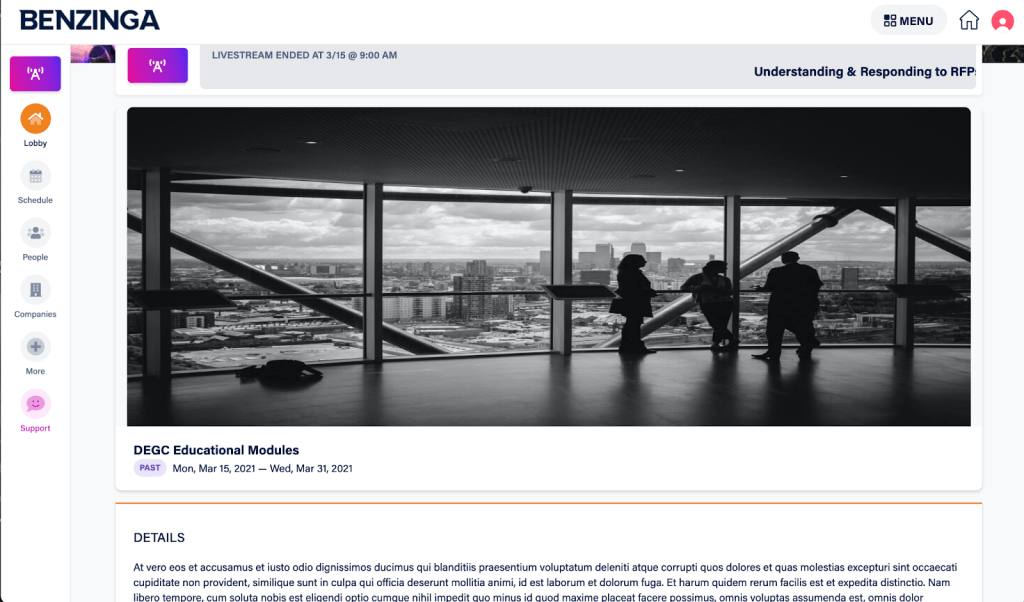
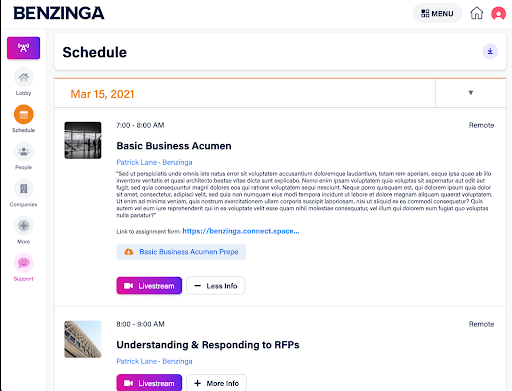
First, we began with realistic mockups that were designed with Connect Space constraints in mind that DEGC could contract Connect Space to implement. These designs were based on screenshots from ConnectSpace that we edited in Figma. Additionally, we used the sandbox account to build out these educational modules in the platform.
Next, we built a prototype without the constraints of the platform with a greater focus on user experience and a vision for the product rooted in the research we conducted.
Wireframing
Starting off, our first goal was to try and figure out how to host an online course in an event planning SaaS platform. This wasn’t ideal because of course the software was designed for virtual events rather than online learning. So at the wireframing stage we tried to broadly envision how some of the features within Connect Space could be used for online learning. For example, where there was an agenda of events for a conference, those events could instead become lessons in a course.

Connect Space
Ultimately we ended up doing a lot of research into how Connect Space works, including meeting with the company’s founder to give us a full walkthrough and answer all our questions. He gave us access to a sandbox environment where we built a demo of the Supplier Advancement Program for DEGC, which is the screenshots you see to the left.
Custom Designs
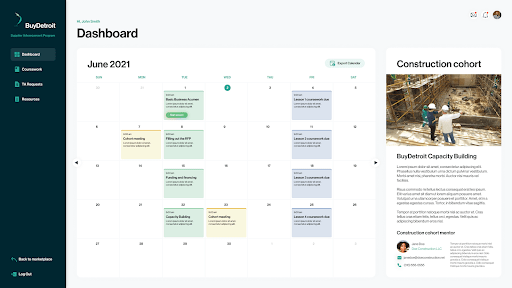
In tandem with our Connect Space designs, we also worked on a fully custom design. The following images display:
- The landing page of our original design for the BuyDetroit learning portal, where suppliers on BuyDetroit can learn about the program and apply to be in a cohort of small business owners mentored by an experienced supplier.
- The dashboard where suppliers can keep track of due dates and meetings and learn about their cohort and the mentor.
- The Coursework tab where there is a space to host all of DEGC’s online learning materials. There’s a roll-up of lessons to choose from, with videos, assignments and an active assignments tracker.
- The technical assistance request form where users can submit a form here and keep track of the status of each of their requests.
- Lastly is the resources page, which is designed to accompany the TA requests. This is an easily searchable and filterable list of organizations in Detroit that provide services to businesses and empower entrepreneurs.



Evaluation Study
In our study we ran a within-subject usability test between our two sets of designs.
We randomized the order of which each participant saw the designs. After seeing both designs, all participants were asked a short set of interview questions to understand what they liked, disliked, and were confused about.
After we completed our evaluation study, we used these findings to recommend specific changes to be implemented by Connect Space to this portion of the portal. These changes directly benefit the users of the education modules. With our findings to back up our proposal, we presented design options of these changes that iterate on our Connect Space designs, and marry the best parts of the two.
If DEGC were to contract Connect Space to add additional features to the portal, the feature included in our custom design that would be most helpful for users would be the course progress tracker.
While contracting Connect Space to add an additional feature is an option to satisfy more system requirements, aesthetics and information architecture are barriers that would be difficult to overcome while constrained to the system’s existing layout and functionality.
Next Steps and Implementation
Solely based on the results of the evaluation study, our team would suggest looking for a different system to host the educational modules. However, given the context of DEGC’s budget and timeline for launching the educational modules our final recommendation is for the educational modules to be implemented within the existing system Connect Space.
The educational modules could be implemented in Connect Space and made fully operational in the BuyDetroit portal as soon as possible. The user experience of this product would not be optimal, but the product would be functional. This tension between producing a viable product and the desire for a good user experience was something our team faced throughout the development of the designs. Implementing the designs in Connect Space will provide DEGC with the minimum viable product they need to get the ball rolling with supplier education.
The designs our team created are not the end all of what the educational modules could be in Connect Space. DEGC should ask for feedback often from the suppliers who participate with the educational modules on the features with which they interact on the site. Regularly asking for feedback from suppliers is a type of constant evaluation of design features which we recommend for these modules. While the design and user experience are limited by the features Connect Space offers, these features can be configured and edited in multiple ways to change the experience for participants.
Housing the educational modules in Connect Space is an important next step for DEGC
in their Supplier Advancement Program. Consistent evaluation of supplier’s experience and open communication with Connect Space on the best practices for implementing features are crucial to the success of these modules.
Results
Our client decided to use the research results and our recommendations to reimagine the Supplier Advancement Program. Inspired by the events of the Connect Space system, DEGC is launching BuyDetroit’s first capacity building event series using the model of events led by experts on the topic to teach small business owners.
The first event will take place on May 25th, 2021 and will focus on business negotiation. While most events will take place online through the Live Stream feature on Connect Space, at least one event this fall is planned to be in person, to provide the suppliers with a networking opportunity.
 Savannah Redlinger